

By Audie Vinci Batausa
I got myself inside a non-air conditioned bus bound for Sapang Dalaga. Beside me was an old man in his late sixties, wearing a pair of slacks and a green plaid shirt. With him was his grandchild, seated comfortably on his lap. Sitting at the backmost part of the bus was a choir of about five to eight chickens. They were singing their hearts out during the entire two-hour trip from Ozamiz City. In an attempt to drown out the horrible singing, I plugged in my earphones and gazed at the passing landscape outside the window.
Life in this part of the country is very laidback and simple. We passed along several hectares of corn fields, rice paddies, and lush forestry. Carabaos were carrying carts full of lumber and various agricultural produce as farmers dragged them along the highway.
You would know that you have already arrived at Sapang Dalaga if you have reached its long and winding uphill roads. Sapang Dalaga is a fifth class municipality located at the boundary between Misamis Occidental and the Zamboanga Peninsula. Its name was derived from the phrase sapa ng dalaga or the maiden by the creek. Coincidentally, my first stop in this town is its most famous water landmark – the Baga Falls.
BAGA FALLS
I got off the bus at the stop near the town’s municipal hall. I immediately saw the row of habal-habal 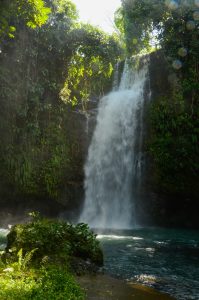 drivers and approached the one nearest to my end. His name was Mang Kaloy. After coming to terms with my itinerary for the day, we bought some snacks composed of biscuits and a bottle of iced tea from the nearby sari-sari store. We then started to kick-off.
The falls were just a five-minute ride away from the town center. To my relief, there was no hiking needed to reach the falls.
As I looked around, it was obvious that conscious efforts have been made by the local government to develop the place. However, according to my guide, raging typhoons wiped out the structures that once stood there. What remained was only the skeletal wooden frames made of coco lumber and the roofing made out of nipa leaves scattered on the ground. This, along with the forest’s uncanny quietude, added some sort of a mystic charm that enveloped the entire area.
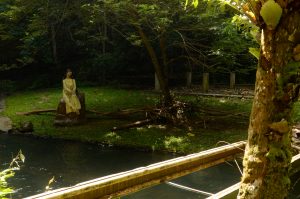 From a distance, the waterfalls grumbled softly as the water cascaded smoothly towards the catch basin beneath it. Diagonal rays of sunlight slanted down through the towering coconut trees, illuminating the falls like a giant spotlight. On the left was a slightly dilapidated statue of a woman seated on a rock. The woman was wearing a long white dress, which appeared a bit yellow due to age, that flowed across her body in a manner that resembled the rolling waters behind it. It then occurred to me that the falls could be the maiden they were referring to in the town’s etymology.
This reminded me of a common character in Philippine folklore – the diwata. They were often described to resemble a woman, beautiful and seemingly ageless, with some having golden skin. They were known to be the guardian spirits of nature, rewarding or cursing those who brought benefits or harm to the forests or rivers.
Unlike some of the falls I’ve seen, Baga’s rawness and virginal beauty were simply inviting. Its humble height of about 60 feet was enough to capture my heart and tug on my heartstrings. It is concrete proof that beauty really does not come as “one-size-fits-all.”
CALUYA SHRINE
After spending a short period of repose at Baga Falls, Mang Kaloy then told me to be prepared for a surprise in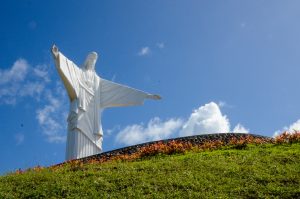 our next destination – the Caluya Shrine.
The Caluya Shrine is the newest attraction in the province of Misamis Occidental. It houses a forty-five-foot replica of the Christ the Redeemer statue found in Rio de Janeiro, Brazil. It is a popular pilgrimage site that is flocked by both tourists and locals from the nearby municipalities, especially during the Lenten Season.
 When we started our ascent, I could already catch a glimpse of the iconic statue with its arms stretched wide at the summit. The motorcycle ride towards the shrine only took us about 30 minutes. We then set off on foot, climbing the hill through the concrete flight of staircases carved on the hillside. When we reached the top, my eyes were drawn, not towards the statue, but towards where its hands were stretched over. The beauty overtook my senses as I looked out to the sun-speckled view below. To be honest, I was more than surprised.
The waters of Murcielagaos Bay shone like a precious jewel. Its waters were still and undisturbed, 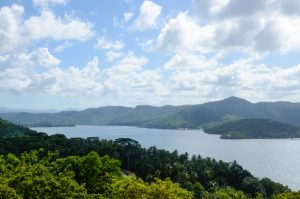 almost motionless, as they surrounded the nearby island of Naputhas. Several floating cottages dotted the waters, like small black blotches in an artist’s deep blue canvas. On the other end is the Dioyo River, which appeared like a grayish green ribbon as it twisted its way around to meet the sea.
These different aspects all blended together to create a sight so striking. Under the scorching heat of the sun, I stood in awe and basked in the beauty that the view possessed. I stayed that way for a long time, lost in reverie, as the subtle scent of the sea filled my nostrils.
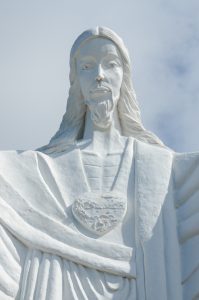
As we were getting ready to head home, I gave the statue of Christ the Redeemer one last look when I noticed something different. Unlike the one in Brazil, the statue here in Caluya Shrine has a heart – and etched on the heart is the town of Sapang Dalaga.
