

by Ten Ilajas
I should have stayed at the hostel—better yet, I should have stayed home. I was lost in the little alleys of Singapore with my phone signaling that it would switch off unless I connect it to a power source. I am young, and like most Filipinos, I dreamed of working abroad to follow my dreams. At the same time, I was so scared of jumping out of my comfort zone and leaving home—but this is it.
I had a solo stopover in Singapore before flying to Dubai and taking part in the Overseas Filipino Workers’ circle. The initial plan was to stay in a capsule hotel and spend my days on the usual theme parks and attractions, but because I am not a crazy rich Asian—rather, an even crazier poor one—I experienced Singapore as a wandering backpacker, reflecting and observing the normal lives of people in the country.
I checked in to a hostel at Joo Chiat where I stayed with people with different nationalities, along with a cat. They served free marmalade, peanut butter, and slightly burned toast for breakfast, plus good conversations over mugs of unlimited instant coffee.

Each morning, I would stroll down the alleys of Joo Chiat and pass by the colorful shophouses that lined the streets. These were stores influenced by the Peranakans, known as the Chinese immigrants who came to Singapore in the early times and settled in the country. The term “shophouse” was coined based on the function of the establishments. The first floor was usually a shop while the second floor was the owner’s house, thus the term “shophouse.” The structures were so well-preserved that they have become tourist attractions; at the same time, some are still used as shops while others remained as houses. The second-floor buildings were of different pastel colors. The roofs were made of red and orange clay. The French windows were huge and outlined with patterns and carvings. Some shops had vines crawling around intricately wielded steel gates. There were mailboxes engraved with numbers and names that I carefully read as I passed by.
As I strolled around the city, I relied on Google Maps and the very fast data connection. 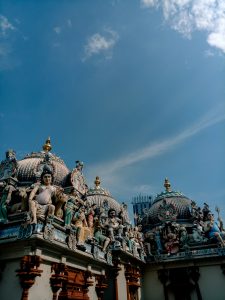 I would drop by vinyl record stores, local bakeries, temples, and more shops. What was great about Singapore aside from the diversity and richness of its culture is its people. They are very welcoming, even in their places of worship and faith. Barefoot, I went inside temples where believers offered milk, coconuts, and flowers to their deities. In some temples, they offered free tours and incense for your prayers. Some offered food to share with everyone inside—even tourists get to share the meal.
The ceilings of the temples depict stories of how the people of Singapore respect their deities and tradition despite it being a city of development.
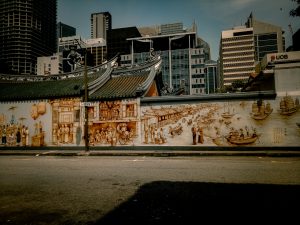 Some walls in the city also show the history of how the Chinese immigrants sailed to Singapore and made it their home. Statues depicting the normal lives of the settlers can often be seen on the streets and in parks. Sometimes, I would wonder how these things are not that featured in magazines or blogs or how such history and culture are underrated.
Singapore has a lot to offer—more than its theme parks and its world-famous airport.
As I was so absorbed with observing how clean the pavements were and how awe-inspiring the beautiful architecture of buildings was, while snapping photos here and there, I got lost in the alleys.
I walked past small-caged windows, rust-eaten exhausts, full trash bins, parked bikes, stray cats, paint-chapped doors, and empty, cold, and unfamiliar streets. It was starting to get dark, and my phone’s battery was almost out. Droplets of rain started to hit the dry concrete road, petrichor spreading through the atmosphere. I slowly felt fear creeping in, and then waves of nostalgia hit my lonesome soul. I was thousands of miles away from home, alone and lost.
It felt like I was in the movie Spirited Away where Shohiro was lost one hazy afternoon in an old abandoned theme park inhabited by enchanted beings. I sat on one of the benches and searched my backpack for a power bank, only to find out that I left it at the hostel. What I had were the free brochures of the colorful shophouses with maps on them. The lights of the establishments were slowly lighting up like the idea that just popped – I can find my way back by using the brochures. After a few hours of navigating and asking for directions, I found my way back to the shophouses at Joo Chiat and, eventually, the hostel.
It is at that moment—while lost in the alleys—that I realized that life is not always as colorful as the shophouses in Joo Chiat, but it makes us appreciate the beauty of trying to find ways toward our dreams and aspirations. Despite being broke after working for almost a lifetime, being lost after planning everything out, the hurt, the scars, and the dreaded  shrill sound of the alarm clock in the morning, we are still able to rise up, be brave, and move forward.
Leaving home might be a scary decision, with no promises of anything ahead. However, it is in being lost that we are found and in leaving home that we realize that there will be no place like it.
When we are lost, we need to remember how colorful life is despite it being lonely at times. Just enjoy the journey. Snap photos. Take a selfie. Chat with locals. And eat a large bowl of Laksa. Finding my way back to the shophouses may not be as comforting as going home, but let us hope that we find our ways to places and people that our hearts belong to—wherever we are in this colorful world.
